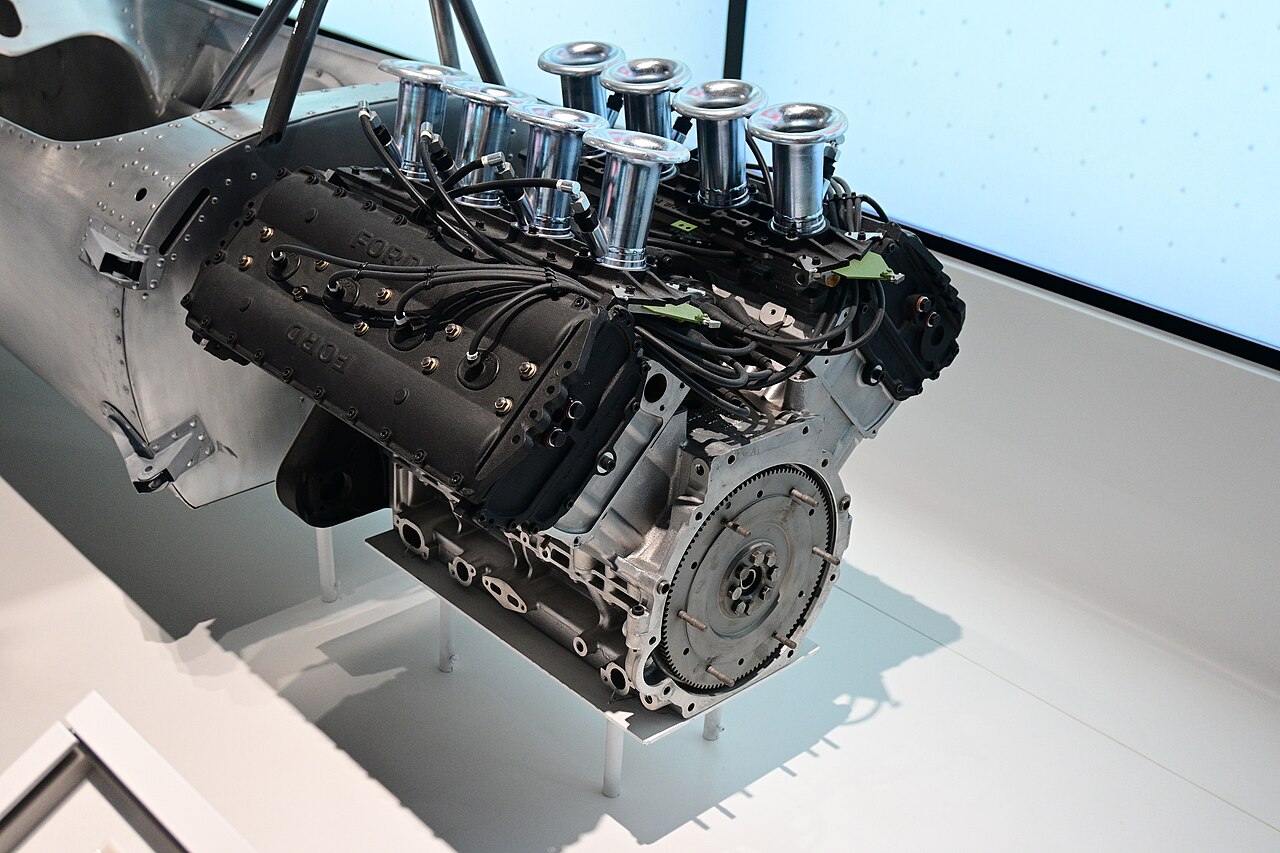
With F1 agreeing to bring back V8 engines from 2030, here are six true stories from the engine bay.
1. A 16-cylinder engine won a Grand Prix
BRM built an H16 for 1966: in effect two flat eight-cylinder engines stacked on top of each other and geared together. It was heavy and troublesome.
It won exactly once. Jim Clark took the 1966 United States Grand Prix at Watkins Glen with it in a Lotus 43, the only world championship win for a 16-cylinder engine.
2. The most famous V8 won on its debut
Lotus boss Colin Chapman asked Keith Duckworth of Cosworth for a new three-litre engine, and Duckworth said he could build one for £100,000. The result was the Ford Cosworth DFV.
At its first race, at Zandvoort on 4 June 1967, Graham Hill put it on pole and Clark won.
3. One engine won every race of two seasons
The DFV powered the winner of every world championship race in 1969 and in 1973. Lotus, McLaren, Tyrrell, Williams and many more teams bought it.
It took 155 wins from 262 races between 1967 and 1985. Michele Alboreto scored its last at the 1983 Detroit Grand Prix for Tyrrell.
4. The first turbo was nicknamed "the yellow teapot"
Renault's RS01 was the first F1 car with a turbocharged engine when it appeared at the 1977 British Grand Prix. Rivals called it the yellow teapot because it blew up so often, usually in a cloud of white smoke.
Renault kept going. Jean-Pierre Jabouille won the 1979 French Grand Prix at Dijon: the first win for a turbo car, in a French car on French tyres with French fuel.
5. A road car engine block powered a world champion
BMW's turbo F1 engine was a 1.5-litre four-cylinder based on the M10, a road car engine first built in 1961. Nelson Piquet used it to win the 1983 title with Brabham, the first drivers' title for a turbo engine.
By 1986 BMW claimed about 1,400 horsepower in qualifying trim.
6. A W12 team never made the grid
Life entered the 1990 season with a W12 engine designed by former Ferrari engineer Franco Rocchi. It was the least powerful engine of the year.
The team failed to get through pre-qualifying in all 14 attempts. Its longest run was 22 laps in pre-qualifying at Silverstone.
Race it on Late Brake
Silverstone, where Life managed its longest run, is one of six real circuits in Late Brake, along with Monza, Spa-Francorchamps, Spielberg, Monaco and Interlagos. Set a medal time there and then chase it in an online race.
Sources: Wikipedia: BRM P83, Wikipedia: 1966 United States Grand Prix, Wikipedia: Cosworth DFV, Wikipedia: Renault RS01, Wikipedia: 1979 French Grand Prix, Wikipedia: BMW M12, Wikipedia: Life Racing Engines